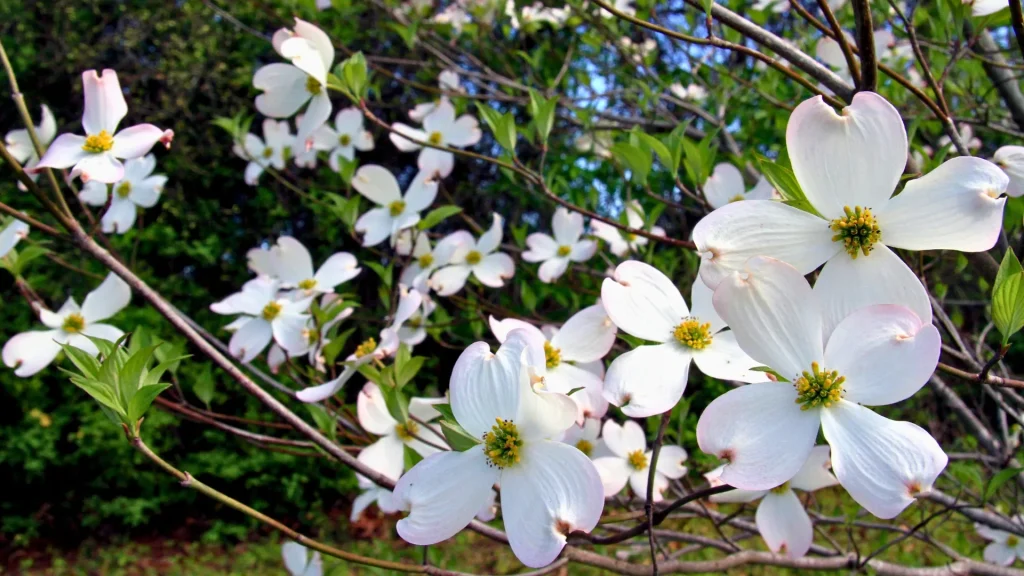
Dogwoods (Cornus spp.) enjoy worldwide notoriety, but they’re especially beloved by Atlanta-area residents. They’re not only important parts of our native forests, but they’re also deliberately planted on properties across the region. We even have an annual festival inspired by their spring blooms.
But unfortunately, there are a few things that can cause dogwoods to struggle. Super-compacted soils and scorching sunlight will both make them struggle, but one of the biggest threats they face comes courtesy of a fungal disease called dogwood anthracnose.
We’ll explain everything you need to know about this disease, including the best ways to protect your trees from it, below.
What Is Dogwood Anthracnose?
Dogwood anthracnose is an introduced disease that is thought to have originated in Asia. Caused by the fungus Discula destructiva, the disease was detected in New York way back in the 1970s, and it had spread to North Georgia by the late 80s.
There are a number of different kinds of anthracnose, and each infects a different tree species (or group of tree species). For example, Apiognomonia veneta causes sycamores (Platanus spp.) to get anthracnose, while a variety of different fungi can cause the disease to occur in maples (Acer spp.).
Many kinds of anthracnose only cause minor foliar damage. The infected tree may lose a large portion of its leaves, but it’ll often produce a second flush of growth later in the season. Unless the tree is repeatedly infected or simultaneously battling other stressors, it’ll usually recover.
Dogwood anthracnose, on the other hand, is a little more serious. In addition to infecting the leaves, it can also infect the showy white or pink bracts (the part people think of as the flower), new shoots, twigs, and even large branches or trunks at times.
As the disease progresses, cankers can develop and girdle branches or the main stem, potentially killing the tree.

Common Symptoms of Dogwood Anthracnose
Dogwood anthracnose can cause a number of different symptoms, including:
- Leaf Spots: Tan or brown spots with reddish-purple margins may develop on leaves, often beginning along the margins or veins. These spots can expand and merge over time.
- Bract Spots: The showy white or pink bracts surrounding the flowers may develop spots or patches of dead tissue similar to those found on the leaves.
- Twig Dieback: The fungus can spread from infected leaves into young shoots and twigs, causing them to die back.
- Branch Cankers: Sunken or discolored cankers may develop on infected branches and eventually expand enough to girdle the branch.
- Epicormic Sprouts: Stressed trees may produce numerous shoots along the trunk and larger branches. If these sprouts become infected, they can allow the fungus to move into the trunk.
- Trunk Cankers: In advanced cases, cankers may develop on the trunk. If a canker completely girdles the main stem, it will kill the entire tree.
- Crown Dieback: As twigs and branches are killed, the tree’s crown may become increasingly thin and sparse.
Which Dogwoods Are Most at Risk?
While various dogwood species obviously have a number of similarities, they exhibit some stark differences with respect to their vulnerability to dogwood anthracnose.
- Flowering dogwood (Cornus florida): One of the primary hosts of dogwood anthracnose, our native flowering dogwood is extremely susceptible to dogwood anthracnose.
- Pacific dogwood (Cornus nuttallii): As with the flowering dogwood, the Pacific dogwood is considered a primary host for this fungal disease.
- Kousa dogwood (Cornus kousa): In contrast to the flowering and Pacific dogwoods, Kousa dogwood is somewhat resistant to the disease, though it is not immune.
- Cornelian cherry dogwood (Cornus mas): The Cornelian cherry dogwood has demonstrated resistance to dogwood anthracnose and can be a useful alternative to consider.
- Alternate-leaf dogwood (Cornus alternifolia): Also called the pagoda dogwood, this species is typically regarded as resistant to dogwood anthracnose.
It’s worth noting that dogwoods are also available as a number of hybrids and cultivars, and many of these have been bred or selected specifically for improved resistance to dogwood anthracnose.
Dogwood Anthracnose: Treatment and Management Options
Unfortunately, there aren’t any magic bullets in the battle against dogwood anthracnose. Once a leaf, shoot, bract, branch, or trunk has become infected, there’s no reliable cure.
With that said, there are several things you can do to help protect your dogwoods from anthracnose, including:
- Install resistant cultivars. While this won’t help you protect an existing tree, it can allow you to avoid problems with dogwood anthracnose in the future.
- Rake up shed leaves. By collecting and properly disposing of infected leaves, you can reduce the amount of inoculum and the chances of reinfection next year.
- Support your tree’s health. By watering your dogwood during dry periods, protecting it from damage, and mulching the root zone, you can help ensure its defenses are primed.
- Prune infected branches. By removing already-infected branches, you can help reduce the amount of inoculum in the area and prevent the disease from spreading farther.
- Avoid overhead irrigation. Overhead irrigation can encourage the foliage to stay damp, which will in turn provide conditions that support fungal growth and development.
- Treat your trees with a fungicide. While treatments are ineffective for curing infected trees, they can be used to prevent anthracnose from developing when applied at the correct time.
Ultimately, the best option for most homeowners is to contact a team of tree-care professionals, who can evaluate their trees and recommend the most appropriate management strategy.

Dogwood Anthracnose Questions: FAQ
Dogwood anthracnose can be a serious disease, but its severity varies depending on the tree, the conditions it’s growing in, and the extent of the disease. The following questions can help you better understand what an infection may mean for your dogwood.
What are the symptoms of dogwood anthracnose?
Dogwood anthracnose can cause tan or brown leaf spots, scorched-looking leaf margins, twig dieback, branch cankers, and progressive thinning of the crown. In advanced cases, cankers may develop on larger branches or the trunk and potentially girdle the tree.
Will dogwood anthracnose kill my tree?
It certainly can. Mild infections may only affect the foliage, but severe infections can spread into shoots, branches, and the main stem. Repeated or extensive infections can cause significant dieback and may eventually prove fatal.
How do you treat dogwood anthracnose?
Management typically involves pruning infected branches, removing fallen leaves and other infected material, and supporting the tree’s overall health. Fungicides may also be used to protect susceptible new growth, particularly on valuable trees with a history of infection.
Can fungicides cure dogwood anthracnose?
Fungicides can help prevent new infections, but they cannot restore leaves, shoots, or branches that are already infected. For this reason, treatments are generally most effective when they begin around bud break and are applied preventively.
Should I remove a dogwood with anthracnose?
Not necessarily. Trees with relatively limited infections may be manageable with pruning, sanitation, appropriate cultural care, and preventive fungicide treatments when warranted. However, removal may be appropriate when a tree has extensive dieback, severe trunk cankers, or has declined to the point that recovery is unlikely.
Can I plant another dogwood if anthracnose is a problem?
Yes, but species and cultivar selection can make a significant difference. Kousa dogwoods are generally more resistant than flowering dogwoods, and a number of dogwood cultivars and hybrids are available that have been selected or bred for improved anthracnose resistance.
Is dogwood anthracnose contagious?
Dogwood anthracnose can spread from infected trees and plant material to susceptible dogwoods nearby. The fungus produces spores that are dispersed primarily by splashing water, making cool, wet spring weather especially conducive to disease development and spread.
AKA Tree Service: Protecting Georgia’s Dogwoods
If you suspect that your dogwoods are suffering from anthracnose, or you just feel like they’re not thriving the way they should, it can be helpful to secure professional help. The AKA Tree Service team will be happy to schedule an evaluation, examine your trees, and lay out the best ways to protect them.

Contact us today to get started and keep your dogwoods safe!
Sources and References
- Arboriculture & Urban Forestry (ISA) – “Cause and Control of Dogwood Anthracnose in Northeastern United States”
Peer-reviewed research article by Daughtrey, Hibben, and Hudler identifying Discula sp. as the cause of dogwood anthracnose dieback, with fungicide trial results and management recommendations.
https://auf.isa-arbor.com/content/14/6/159 - USDA Forest Service – “Dogwood Anthracnose: How Collaboration Was Used in the Southern United States to Effectively Deal with a New Tree Disease”
Federal conference paper by Robert L. Anderson describing the multi-state, multi-agency working group formed to coordinate research and response after dogwood anthracnose (Discula destructiva) reached the Southern U.S. in 1987.
https://research.fs.usda.gov/treesearch/43250 - Tennessee State University – “Dogwood Anthracnose”
Extension publication by Baysal-Gurel, Kabir, and Randaci covering dogwood anthracnose identification, biology, and management for Tennessee landscapes.
https://digitalscholarship.tnstate.edu/cgi/viewcontent.cgi?article=1117&context=extension - University of Florida IFAS Extension (EDIS) – “Dogwood Anthracnose: A Threat to Flowering Dogwood”
Extension circular by Holzmueller, Jose, and Long documenting dogwood anthracnose’s spread from its 1970s New York origin through the Appalachians, and mortality rates as high as 95% in affected areas.
https://www.researchgate.net/publication/237688218_Dogwood_Anthracnose_A_Threat_to_Flowering_Dogwood1 - University of Georgia Extension – “Dogwoods”
UGA county extension article on flowering dogwood, covering identification, growing conditions, and the common diseases and pests affecting dogwoods in Georgia landscapes.
https://site.extension.uga.edu/townsandunionag/2019/12/dogwoods/